
 Français
 English


EXHIBITION // CIBLES / TARGETS // GALERIE KAMEL MENNOUR // PARIS
- News
- 1589 views
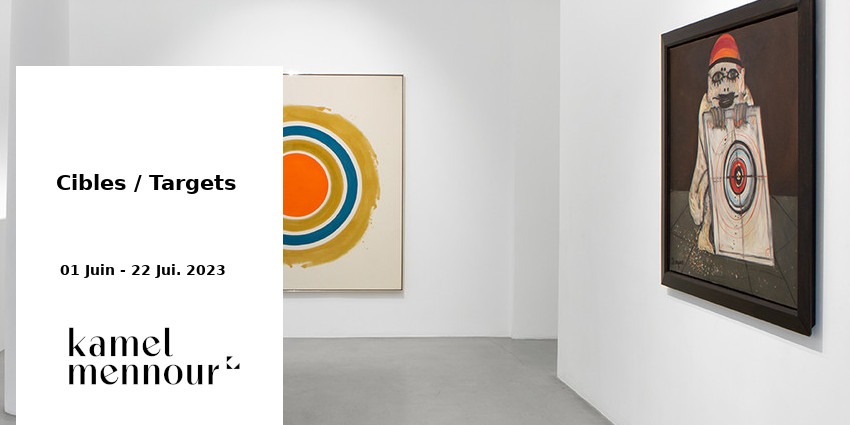
© Kamel Mennour Gallery
Cibles / Targets from 01 June to 22 July 2023
Galerie Kamel Mennour
47 rue Saint André des Arts
75006 Paris
https://mennour.com
ROGER BALLEN, ALFRED COURMES, SONIA DELAUNAY, MARC DESGRANDCHAMPS, MARCEL DUCHAMP, PAUL ÉLUARD, MICHEL FRANÇOIS, GILGIAN GELZER, BERTRAND LAVIER, MARYAN, FRANÇOIS MORELLET, GEORGES NOËL, KENNETH NOLAND, GINA PANE, PABLO PICASSO, MAN RAY, MARTIAL RAYSSE, UGO RONDINONE, NIKI DE SAINT PHALLE, FRANCK SCURTI, AGNÈS THURNAUER
Nothing is easier to define than a target: a circle of colored rings used for shooting exercises. Why dedicate an exhibition to this simple shape? To demonstrate how it can encompass various and sometimes complex meanings. The goal, therefore, is not to provide an exhaustive inventory but to show how a theme that might seem simple can evoke many variations.
A target, of course, is what the archer, sniper, or firing squad aims at. The idea for the exhibition was born from the Character of Maryan holding a target in front of him. The painting is autobiographical since Maryan survived by chance the bullet fired at him by a drunken Nazi soldier. Here, the target is a symbol of death. Alfred Courmes is also explicit: a teenage Saint Sebastian with arrows piercing his belly, an archer praised by his wife for his deadly accuracy. Man Ray also shoots with a bow, but not to kill. Georges Noël's target, on the other hand, is much more disturbing.
On the contrary, a target can be a symbol of amorous desire striking at the heart. Martial Raysse symbolizes it with a nude and armed dancer. Agnès Thurnauer's "Not Yet" is more ironic since the goal, whatever it may be, has not yet been reached, according to what is written. As for the targets on the backs of the young people portrayed by Marc Desgrandchamps, it is undoubtedly a reference to The Who and their drummer Keith Moon, who popularized the T-shirt adorned in this way in the 1960s. But there is no prohibition against interpreting it in a more romantic way.
From the perspective of art history, a target is a geometric abstraction made of circles, as opposed to one that cultivates right angles. The orthogonal one represents order and stability, while the circular one signifies movement and disturbance. This has been the case since the "Rhythms" of Sonia and Robert Delaunay. Marcel Duchamp's "Rotoreliefs" create optical effects that disturb perception, a technique also achieved in a different manner by François Morellet.
By adding a sphere painted with concentric blue circles to a piece of furniture, Franck Scurti creates the illusion of a profile and an eye. Gina Pane segments and disperses circles and curves, evoking thoughts of wave diffusion and planetary gravitation around a central sun. Pablo Picasso captures the power of attraction and blindness with just a few orbs and a black spot. Are the works of Kenneth Noland, Bertrand Lavier, and Ugo Rondinone abstractions or cosmogonies? Or both at the same time? Is Gelzer's work an abstraction or a choreography? And these are just a few of the variations. Here's another one: when Michel François encloses the rays of marcasite (crystallized iron suns) within paper windings, he reveals an ouroboros, that mythical serpent common to many ancient religions that forms a circle—a never-ending line, like this subject.
— Philippe Dagen, exhibition curator.